If you’re a marine engineer, ship owner, or HVAC contractor, one of the most critical
decisions in any vessel cooling system is the compressor choice. In the marine
refrigeration and HVAC space, the face‑off “Carlyle vs Bitzer compressor for
ships” comes up constantly in technical meetings, procurement briefs, and
service‑log reviews.
Both brands are trusted in industrial and marine refrigeration, but when salt air,
vibration, and long‑haul logistics are in play, even small differences in build
quality, efficiency, and service life can swing operating costs and
reliability. This post cuts through the marketing noise and compares Carlyle vs
Bitzer compressors specifically for ships, helping you decide which
compressor is the better fit for your vessel type, budget, and maintenance strategy.
Why Compressor Choice Matters on Ships
The compressor’s role in a marine refrigeration system
At the heart of every ship refrigeration system is the refrigeration cycle
powered by the compressor. The compressor drives high‑pressure refrigerant from
the evaporator to the condensing unit, enabling heat extraction from engine
rooms, cargo holds, galleys, and cabins.
For marine HVAC and refrigeration, the compressor must:
● Handle frequent load swings (port vs sea, laden vs ballast).
● Operate in high‑humidity, salt‑laden environments.
● Maintain consistent temperature control for cold chain shipping and
marine cold storage.
A poor compressor choice can lead to excessive downtime, higher
fuel‑equivalent energy cost, and compromised cargo quality.
Commercial impact of compressor selection
From a commercial intent standpoint, compressors directly affect:
● Fuel‑equivalent energy cost (compressor efficiency for ships).
● Maintenance and spare‑parts cost (marine refrigeration maintenance).
● Asset‑life decisions (whether to overhaul or replace refrigeration plant).
That’s why understanding Carlyle vs Bitzer compressors for ships isn’t just
technical—it’s a CAPEX vs OPEX decision that shapes vessel profitability.
Overview of Carlyle Compressors for Marine Use
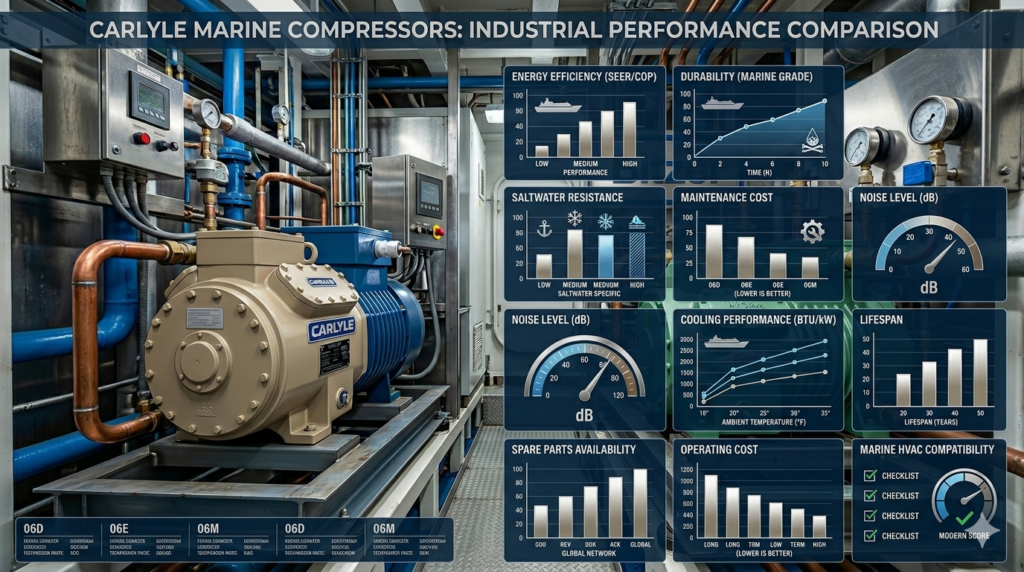
Carlyle (historically a Carrier brand) is widely used in industrial and marine
refrigeration, especially in larger, semi‑hermetic systems.
Key traits of Carlyle marine compressors
● Semi‑hermetic design common in large marine units, allowing internal
repairs without full replacement.
● Broad capacity range suitable for large cooling systems, including ship
engine room temperature control and marine cold storage rooms.
● Good refrigerant compatibility with common marine refrigerants
(R‑404A, R‑448A and newer HFOs depending on model).
Typical marine applications
● Cargo ships (reefer containers, chill rooms).
● Offshore platforms (galley, crew quarters, technical rooms).
● Marine cold storage and reefer vessels with centralized refrigeration
plants.
Carlyle compressors are often favored where long‑term serviceability and
repairability are prioritized over “plug‑and‑play” field replacement.
Overview of Bitzer Compressors for Marine Use
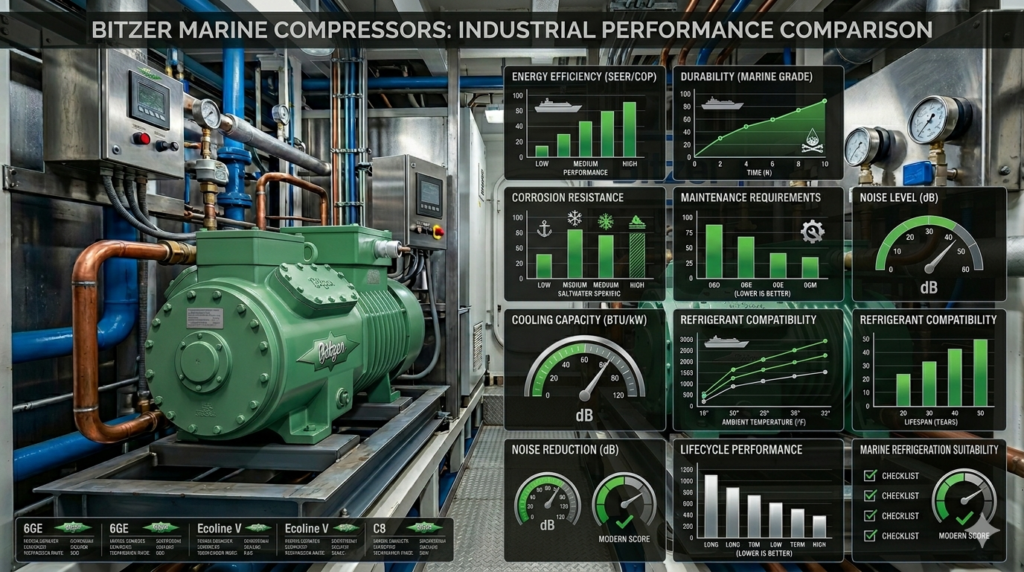
Bitzer is a major European brand dominating commercial refrigeration and
marine HVAC, known for robust scroll, screw, and piston designs.
Key traits of Bitzer marine compressors
● Strong presence in marine HVAC compressor and marine
refrigeration compressor markets, especially in condensing units and
chillers.
● Emphasis on energy efficiency, low‑noise operation, and compact
design, which suits space‑constrained vessels.
● Wide range of marine‑rated compressors with options for oil‑free
operation (screw) and variable‑speed drive (VSD) compatibility.
Typical marine applications
● Cruise ships and ferries (air‑handling units, chillers).
● Fishing vessels and reefer cargo ships (cold rooms, refrigerated holds).
● Offshore platforms and supply vessels with packaged HVAC systems.
Bitzer is often chosen where high efficiency at partial load and strong
brand‑backed support are critical.
Carlyle vs Bitzer: Technical Comparison for Ships
Build quality and marine performance
Feature
Main
architect
ure
Typical
use case
Structure
Carlyle
Predominantly piston‑type
semi‑hermetic for large plants.
Large marine cold storage,
engine‑room chillers, central
refrigeration plants.
Cast‑iron or robust steel bodies; built
for long‑term service runs.
Bitzer
Mix of scroll, screw, and piston
in marine‑rated versions.
Packaged marine HVAC units,
chillers, and compact
refrigeration systems.
Precision‑cast casings with
corrosion‑resistant coatings on
marine models.
Carlyle excels in heavy‑duty, less modular applications where overhaul
and rebuild are acceptable.
● Bitzer leans toward compact, engineered units designed for easier
integration into ship HVAC systems.
Reliability and lifespan
● Carlyle:
● Semi‑hermetic compressors can be opened, critical parts replaced,
and lifespan extended significantly with proper maintenance.
● Often seen in vessels where marine compressor durability is
measured in decades, especially in older and mid‑life fleets.
● Bitzer:
● High reliability in continuous operation, backed by strong field
presence and service networks.
● Lifespan is typically long but less forgiving of poor maintenance;
many units are designed as replace‑rather‑than‑rebuild in severe
marine environments.
For marine compressor comparison, Carlyle often wins on potential
maximum service life, while Bitzer scores on mean‑time‑between‑failure
(MTBF) when properly maintained.
Corrosion resistance and salt‑water conditions
Marine environments demand corrosion‑resistant compressor housings,
coatings, and compatibility with salt‑laden air.
● Bitzer offers marine‑coated and marine‑grade compressors with special
finishes and materials to resist salt spray and humidity.
● Carlyle relies more on robust metallurgy and design; corrosion
protection is often added at the packaged unit / condensing unit level
rather than the compressor casing alone.
For which compressor lasts longer in saltwater conditions, Bitzer
marine‑specific models usually have a slight edge, but well‑enclosed Carlyle units
in clean machine rooms can still deliver excellent service life.
Energy efficiency and operating cost
Efficiency directly impacts compressor efficiency for ships, which affects
generator load and fuel‑equivalent cost.
● Bitzer:
● Scroll‑type marine compressors are generally more efficient at
partial load, important for variable‑demand ship HVAC
systems.
● Many models support VSD / inverter control, allowing
load‑following operation and reducing energy use over the voyage.
● Carlyle:
● Piston‑type units are often efficient at full load but may lag in
part‑load efficiency compared with modern scrolls.
● Their efficiency profile is well‑suited for base‑load marine
refrigeration systems (e.g., dedicated cold rooms) rather than
fluctuating air‑conditioning loads.
For marine cooling compressor duty with variable‑load ship HVAC, Bitzer
frequently has the lower long‑term operating cost.
Maintenance requirements and spare‑parts
availability
This is a major commercial intent driver for ship owners and maintenance
companies.
● Carlyle semi‑hermetic compressors:
● Can be opened and repaired in the field (valves, bearings, pistons
replaced).
● Parts are widely known in the industrial refrigeration world, but
marine‑specific kits may require longer lead times compared with
mass‑market brands.
● Bitzer:
● Many marine units are designed as service‑friendly but not fully
rebuildable; bearings and seals are swapped, but major overhauls are
often discouraged.
● Spare parts availability is generally stronger globally, thanks to a
dense network of distributors and service centers.
For which compressor has cheaper maintenance?
● Carlyle often wins where in‑house marine engineers can perform
overhauls, cutting long‑term costs.
● Bitzer often wins where quick replacement and global parts access
matter more than rebuild economics.
Noise levels and vibration
On cruise ships, passenger vessels, and crew‑heavy offshore platforms,
compressor noise and vibration are critical for ship HVAC system performance
and comfort.
● Bitzer:
● Scroll and screw designs are inherently quieter and smoother
running than piston units, especially in compact HVAC packages.
● Carlyle:
● Piston compressors are typically louder and produce more vibration,
which must be addressed via vibration‑isolated mounts and
acoustic enclosures.
For best compressor for marine HVAC systems where noise control is a
priority, Bitzer is often the preferred choice.
Refrigerant compatibility and future‑proofing
Modern marine refrigeration solutions must cope with tightening regulations
on refrigerant gases (ODP, GWP, and safety).
Both brands offer models compatible with low‑GWP refrigerants such as
R‑448A, R‑449A, and next‑generation HFOs, depending on the marine series.
● Choose compressors with clear retrofit paths and
manufacturer‑certified refrigerant charts to avoid future obsolescence.
Detailed Comparison Table: Carlyle vs Bitzer for Ships
| Feature | Carlyle | Bitzer |
|---|---|---|
| Main Architecture | Semi-hermetic piston and screw compressors mainly for industrial and marine refrigeration. | Scroll, screw, and piston compressors with dedicated marine and offshore ranges. |
| Core Strength | Heavy-duty rebuildable compressors with long operational life. | High efficiency, compact design, and strong automation compatibility. |
| Marine Reputation | Common in traditional cargo vessels and centralized cold storage systems. | Widely used in cruise ships, offshore platforms, reefer ships, and modern HVAC plants. |
| Efficiency | Excellent at full-load conditions. | Superior part-load efficiency with VSD support and intelligent control modules. |
| Noise & Vibration | Higher vibration and operating noise in reciprocating models. | Lower noise and smoother operation, especially in screw and scroll models. |
| Maintenance Style | Fully repairable internals; ideal for onboard rebuild culture. | Easier servicing, but some models favor module replacement over deep rebuilds. |
| Spare Parts Availability | Good in North America and industrial fleets; slower in remote ports. | Very strong global spare-parts and service network. |
| Best Use Case | Engine-room chillers, marine cold storage, and traditional vessels. | Cruise ships, offshore HVAC systems, reefer vessels, and modern marine applications. |
| Part-Load Performance | Less efficient at fluctuating loads. | Excellent part-load optimization and energy savings. |
| Maintenance Score (1–5) | 4/5 – Highly serviceable but requires skilled marine engineers. | 4.5/5 – Easy servicing with advanced diagnostic support. |
| Initial Cost | Usually lower upfront cost. | Higher initial investment but better long-term efficiency. |
| Ideal Vessel Type | Bulk carriers, fishing vessels, and older cargo ships. | Cruise liners, offshore rigs, container ships, and modern fleets. |
Real‑World Use Cases: Which Compressor Wins
Where?
Cargo ships and reefer vessels
For cargo ships with large refrigerated holds and reefers, Carlyle
compressors are often used in centralized refrigeration plants where
capacity, robustness, and repairability are key.
● Best choice for cargo vessels:
● Carlyle when you prioritize overhaul economics and long‑term
asset use.
● Bitzer when you need modern, compact chillers with high
efficiency and low maintenance.
Fishing vessels and offshore platforms
On fishing vessels, salt‑laden air and two‑shift operation demand
corrosion‑resistant and durable marine compressors.
● Bitzer marine compressors are frequently chosen for packaged chillers
serving cold rooms and galleys.
● Carlyle may still appear in older or bespoke refrigeration systems
where the plant has been in place for decades.
Cruise ships and passenger vessels
On cruise ships, comfort, noise, and reliability are paramount for ship
HVAC systems.
● Best compressor for marine HVAC systems: Bitzer is the usual
frontrunner thanks to quiet scroll/screw units, high efficiency, and
easy integration into air‑handling and chiller systems.
Engine room HVAC and marine cold storage
● Engine room temperature control and marine cold storage benefit
from large‑capacity, robust compressors that can run continuously.
● Carlyle semi‑hermetic compressors are strong here, especially on older
vessels where existing plant design matches their architecture.
Which Compressor Is Better for Marine Refrigeration?
If you aggregate all factors—marine performance, reliability, corrosion
resistance, efficiency, and maintenance—there is no single “universal winner.”
● Carlyle is better where:
● You want repairable, long‑life compressors in large, fixed
refrigeration plants.
● Your in‑house maintenance capability is strong, and you care
about overhaul cost savings.
● Bitzer is better where:
● You need modern, efficient, compact compressors with low
noise and easy service.
● Your priority is global spare‑parts access and quick
replacements over full rebuilds.
In modern marine refrigeration systems, Bitzer often edges ahead for
new‑build vessels, while Carlyle remains a solid choice for retrofits and
long‑life industrial‑style plants.
Is Bitzer Better Than Carlyle for Ships?
A direct answer: Yes, Bitzer is generally better for new‑build ships and
modern marine HVAC, but only if your maintenance strategy and budget
align with Bitzer’s service model.
● Bitzer wins on efficiency, compactness, noise, and parts availability,
all of which matter for ship HVAC systems where space and comfort are
tight.
● Carlyle wins on repairability and long‑term rebuild economics for
heavy‑duty marine refrigeration plants.
For a typical modern cargo ship or passenger vessel, Bitzer is usually the
better choice; for older or heavily customized refrigeration plants, Carlyle
can still be superior.
Which Compressor Lasts Longer in Saltwater
Conditions?
In saltwater conditions, marine‑specific Bitzer compressors with
corrosion‑resistant coatings and marine‑grade components are generally
engineered to withstand salt spray and humidity better than standard
industrial units.
● Carlyle can still last a long time in well‑protected, indoor
environments, but its marine‑coating options are less standardized
compared to Bitzer’s marine‑rated lines.
For harsh offshore or tropical environments, Bitzer marine compressors
usually offer better long‑term durability when properly installed and
maintained.
Best Compressor for Marine HVAC Systems
For marine HVAC systems, where comfort, noise, and reliability define
performance:
● Choose Bitzer compressors for air‑handling units, chillers, and
packaged HVAC systems on cruise ships, ferries, and offshore
platforms.
● Use Carlyle only if you are integrating with existing large‑capacity
refrigeration plants or if your maintenance team is skilled in
semi‑hermetic compressor overhaul.
Which Compressor Has Cheaper Maintenance?
This depends on your maintenance model:
● Cheapest maintenance long‑term (own team):
● Carlyle semi‑hermetic (repairable internals, lower lifetime overhaul
cost).
● Cheapest maintenance in terms of downtime and logistics:
● Bitzer (easy diagnostics, strong spare‑parts network, fast replacement
units).
For vessel maintenance companies and ship owners, Bitzer often reduces
total downtime cost, while Carlyle reduces material‑and‑labor cost for
skilled marine engineers.
Best Compressor for Cargo Vessels
For cargo vessels, especially reefer‑equipped ships and larger container
carriers:
● Best overall balance: Bitzer for modern refrigeration and HVAC
packages (high efficiency, compactness, ease of service).
● Best for legacy or centralized plants: Carlyle if you already operate
large semi‑hermetic refrigeration plants and want to extend plant
life via rebuilds.
If you are buying new compressor packages for cargo ships, Bitzer is
usually the better, more future‑ready choice.
Expert Tips for Buyers and Engineers
● Match the compressor type to your duty: use Carlyle for heavy‑duty
base‑load cooling, and Bitzer for variable‑load HVAC and chillers.
● Verify marine‑grade ratings: confirm that the condensing units and
marine evaporator systems are designed for salt‑laden environments,
not just standard industrial ratings.
● Plan for refrigerant future: choose compressors listed for low‑GWP
refrigerants and check manufacturer‑approved retrofit charts.
FAQ Section (Schema‑Style Questions & Answers)
Q: Which compressor is better for marine refrigeration: Carlyle or
Bitzer?
: Bitzer is usually better for new‑build vessels and modern systems due to higher
efficiency, compactness, and better service support; Carlyle is better where
long‑term rebuildable semi‑hermetic compressors suit existing or legacy
plants.
Is Bitzer better than Carlyle for ships?
Yes, for most new ships, Bitzer offers better energy efficiency, lower
noise, and easier maintenance; Carlyle remains strong where in‑house repair
capability and long‑term overhaul economics are key.
Which compressor lasts longer in saltwater conditions?
Bitzer marine‑rated compressors are engineered with corrosion‑resistant
coatings and materials, giving them a longer expected service life in
saltwater environments when properly installed.
Best compressor for marine HVAC systems?
Bitzer is typically the best choice for marine HVAC systems on cruise ships,
ferries, and commercial vessels thanks to compact, efficient, and quiet
scroll/screw compressors.
Which compressor has cheaper maintenance?
Carlyle can be cheaper long‑term if you overhaul in‑house, while Bitzer is
usually cheaper in terms of downtime and spare‑parts logistics, especially in
remote ports.
Best compressor for cargo vessels?
For new or upgraded cargo vessels, Bitzer is generally the best choice for
reefer and HVAC packages; Carlyle is better if you operate existing large
semi‑hermetic plants and want to extend their life via rebuilds.
Conclusion and CTA
The Carlyle vs Bitzer compressor for ships debate ultimately comes down to
application, lifecycle cost, and maintenance strategy, not a one‑size‑fit‑all
answer.
For modern marine refrigeration systems, cruise ships, and cargo
vessels, Bitzer is usually the better fit thanks to efficiency, compactness, and
global support. For legacy plants and heavy‑duty refrigeration, Carlyle
semi‑hermetic compressors remain a strong, cost‑effective option.
If you need help deciding which compressor is best for your specific vessel
type, refrigeration layout, or budget, contact:
Ali Hassan Marine Tr LLC – Marine HVAC & Refrigeration Specialists in
UAE
We offer technical audits, compressor selection, and OEM‑compatible
marine refrigeration solutions tailored for cargo ships, fishing vessels,
cruise ships, and offshore platforms.
�
�
Contact Ali Hassan Marine Tr LLC now for a customized compressor
recommendation and system design for your next vessel.
By optimizing your marine cooling compressor choice, you can reduce
operating cost, extend equipment life, and ensure reliable ship refrigeration
systems on every voyage.