If your vessel is docked at Jebel Ali Port, Port Rashid, or anywhere across the UAE coastline and your refrigeration system has stopped working — every hour costs you money. Marine refrigeration repair in Dubai is a time-critical service, and knowing what went wrong is the first step to getting it fixed fast.
At Ali Hassan Marine, we have been responding to marine refrigeration breakdowns across UAE ports since 2013. Our engineers are port-based, meaning we can mobilise to your vessel within hours — not days. In this guide, we cover the 7 most common marine refrigeration problems we see on vessels in Dubai and UAE waters, what causes them, and exactly how we fix them.
Whether you operate a cargo vessel, passenger ship, fishing yacht, or luxury boat, this guide applies to your refrigeration and HVAC system.
Why Marine Refrigeration Fails in UAE Waters
High Heat and Humidity: UAE’s Unique Challenge
The UAE climate creates extreme stress on marine refrigeration systems. Ambient temperatures regularly exceed 45°C on deck during summer months. These conditions force compressors to work harder, consume more power, and generate higher discharge pressures than they were designed to sustain continuously. The result is accelerated wear on compressor components, capacitors, and electrical systems.
Systems running R404A, R407C, or R410A refrigerants are particularly sensitive to high ambient heat because their operating pressures shift dramatically with temperature changes. Without regular maintenance, these systems will fail faster in Dubai’s summer than in any other climate in the world.
Saltwater Corrosion and Sea Strainer Blockage
Marine refrigeration systems use seawater as the primary cooling medium for their condensers. Gulf seawater is high in mineral content and biological matter. Over time, this deposits scale on condenser tubes and blocks sea strainers — the small filters that protect the seawater inlet. A blocked sea strainer is one of the leading causes of high-pressure alarms and compressor shutdowns in vessels docked across Dubai, Sharjah, and Fujairah ports.
7 Most Common Marine Refrigeration Problems in Dubai
Compressor Failure or Overheating
The compressor is the heart of any marine refrigeration or air conditioning system. Compressor failure is the most costly repair we carry out on vessels across UAE ports. Common causes include:
Oil starvation due to a failed oil separator or low oil level
Liquid slugging — liquid refrigerant entering the compressor suction port
Electrical failure of the motor windings, especially in 60Hz systems
Prolonged high discharge temperature due to high ambient heat or refrigerant overcharge
Worn pistons, rods, or valve plates in reciprocating compressors (Sabroe, Bitzer, Bock, Carlyle)
Warning signs of compressor failure: unusual rattling or knocking noise, high discharge temperature, low suction pressure, repeated HP trips, and complete loss of cooling capacity. If you notice any of these signs, shut the system down and call for a diagnostic immediately. Running a failing compressor will turn a repair job into a full compressor replacement — a significantly more expensive outcome.
We stock genuine and OEM-equivalent parts for Sabroe, Bitzer, Bock, and Carlyle compressors at our Sharjah facility. In most cases, we can carry out a full compressor overhaul without waiting for parts to arrive from Europe.
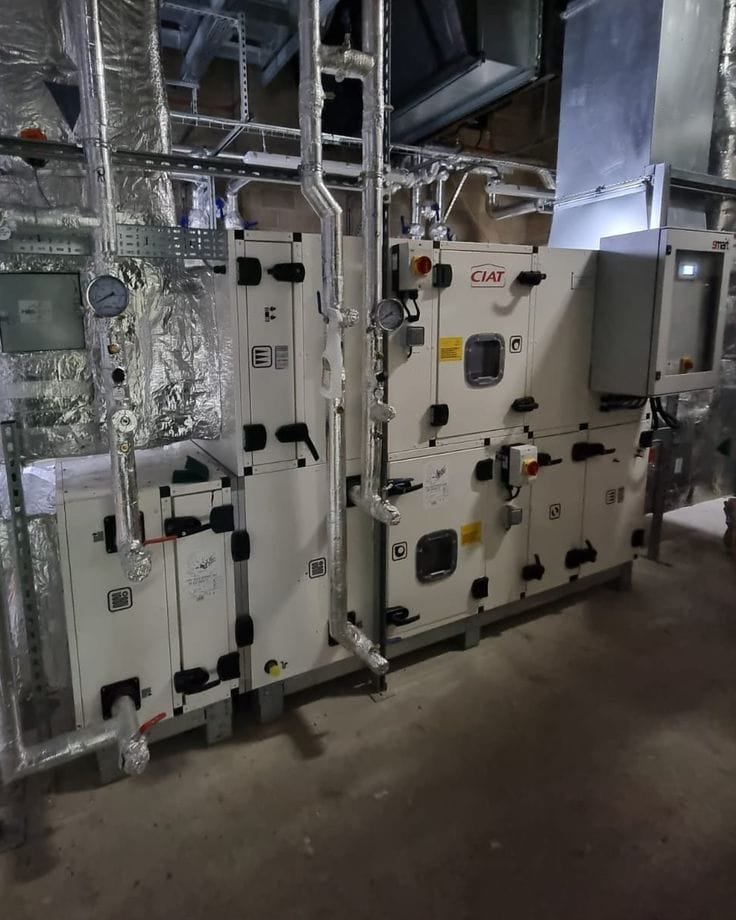
High Pressure (HP) Alarm on Marine AC
The HP (High Pressure) alarm is one of the most common calls we receive from vessels across Dubai ports. When the HP alarm trips, the system shuts down as a safety measure to prevent compressor damage. Do not restart the system more than twice without identifying the cause. Repeated restarts after an HP trip will burn out motor windings and significantly increase repair costs.
Common causes of an HP alarm on a vessel:
Blocked or dirty sea strainer restricting seawater flow to the condenser
Air or non-condensable gases in the refrigerant circuit
Overcharge of refrigerant
Fouled condenser tubes covered in seawater scale and biological growth
Seawater pump failure
The fix: check the sea strainer first. If it is clean and flow is confirmed, the system needs a full diagnostic check of refrigerant pressures, condenser condition, and seawater circuit.
Refrigerant Leak (R404A / R410A Systems)
Refrigerant leaks are common in marine environments due to constant vessel movement, vibration, and the corrosive effect of saltwater on pipe fittings and flare joints. A slow refrigerant leak causes gradual loss of cooling capacity over days or weeks. By the time the crew notices the problem, the system may have lost 20 to 30 percent of its refrigerant charge.
Signs of a refrigerant leak: ice formation on suction lines, compressor running continuously without cooling, low suction pressure, high superheat readings. Our engineers use electronic leak detectors and UV dye testing to identify leaks precisely in the circuit.
UAE regulations require certified recovery of refrigerants such as R404A before any repair work is carried out. Ali Hassan Marine is fully equipped to recover, reclaim, and recharge refrigerants in compliance with UAE environmental regulations.
Condenser Fouling Due to Seawater Scaling
In the Gulf, seawater contains high concentrations of calcium, magnesium, and other minerals that deposit scale on condenser tube surfaces over time. This scale acts as thermal insulation, reducing heat transfer efficiency dramatically. A condenser with heavy scale build-up will cause high condensing pressures, high discharge temperatures, and frequent HP alarm trips.
The solution is a chemical descaling process using approved condenser cleaning agents, followed by a high-pressure flush and inspection of tube condition. For vessels on annual maintenance contracts with Ali Hassan Marine, condenser cleaning is carried out on a scheduled basis to prevent this problem from causing unplanned breakdowns.
Evaporator Ice Build-Up
Ice forming on the evaporator coil blocks airflow and reduces the system’s ability to absorb heat from the protected space. This is particularly common in cargo refrigeration holds and provision rooms on vessels. Causes include:
Defrost system failure (electric defrost heaters, defrost timer, or drain line blockage)
Expansion valve malfunction causing excessive refrigerant flow
Door seal deterioration allowing humid air to enter the refrigerated space
Left unaddressed, ice build-up on the evaporator will eventually stall the evaporator fans and cause compressor short-cycling. Regular defrost system checks are a key part of any marine preventive maintenance programme.
Temperature Setpoint Not Maintained in Cargo Hold
For vessels carrying temperature-sensitive cargo — frozen goods, fish, pharmaceuticals, or perishables — failure to maintain setpoint temperatures is a critical commercial and regulatory issue. In UAE waters, cargo refrigeration systems face additional stress from high ambient temperatures and frequent port loading and unloading cycles.
Common causes: low refrigerant charge, compressor capacity reduction, malfunctioning expansion valve, failed evaporator fans, or control system issues. We carry out a full system capacity test and document results for your cargo documentation and insurance records.
Cabin Water Leakage from Marine AC Unit
Water dripping from marine air conditioning units inside crew cabins or passenger areas is one of the most frequently reported problems. The most common cause is a blocked condensate drain pan or drain line. In a vessel environment, biological matter and algae can quickly clog drain lines, especially in humid months.
The fix is straightforward — drain pan cleaning and drain line flushing — but must be done promptly. Ignoring cabin water leakage leads to mould growth behind wall panels and inside insulation, which is both a health risk for crew and extremely expensive to remediate in luxury vessel interiors.
How We Fix These Problems: Our Repair Process
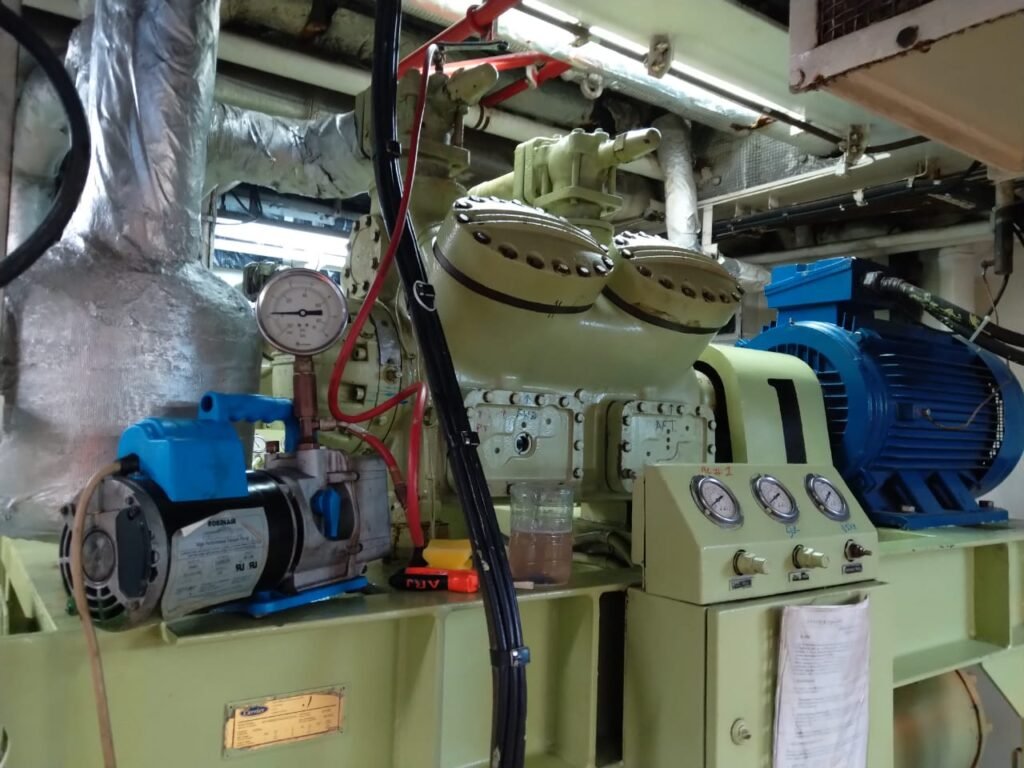
Step 1 – Emergency Mobilisation from Khalid Port / Hamriyah
Ali Hassan Marine is based in Sharjah, minutes from Khalid Port and Hamriyah Free Zone. For Dubai vessels, our response time to Jebel Ali Port and Port Rashid is typically under 4 hours for emergency callouts. We operate 24 hours a day, 7 days a week across all UAE ports.
When you call, our dispatcher will confirm your vessel’s berth location and current system status. This allows us to dispatch the right engineer with the right equipment and parts for your specific system before we even arrive.
Step 2 – Full System Diagnostics and Fault Identification
Our engineers carry digital manifold gauges, electronic refrigerant leak detectors, temperature probes, clamp meters, and compressor oil analysis kits on every marine service call. We do not guess — we measure. A full diagnostic of your marine refrigeration system covers:
Suction and discharge pressure readings
Superheat and subcooling calculations
Compressor discharge temperature measurement
Seawater flow rate and condenser delta-T check
Electrical checks — motor winding resistance, capacitor condition, contactor condition
Refrigerant charge verification and leak test
Step 3 – Repair, Part Replacement and System Recharge
We carry genuine and OEM-equivalent spare parts for Sabroe, Bitzer, Bock, and Carlyle compressors, along with common expansion valves, filter driers, solenoid valves, and refrigerants including R404A, R410A, and R407C. In most cases, repairs are completed in a single visit without waiting for imported parts.
For full compressor overhauls, we carry out a complete strip-down, measurement of all clearances and tolerances, replacement of worn parts to OEM specifications, reassembly, leak test, system vacuum, and recharge.
Step 4 – Documented Technical Report for Your Vessel Logbook
Every job carried out by Ali Hassan Marine is documented with a full technical service report including: system pressures before and after repair, parts replaced with batch numbers, refrigerant quantity recovered and recharged, technician certification details, and a sign-off checklist. This documentation keeps your vessel maintenance log complete, your insurance valid, and satisfies port state control inspection requirements.
Vessel Types We Service Across Dubai and UAE Ports
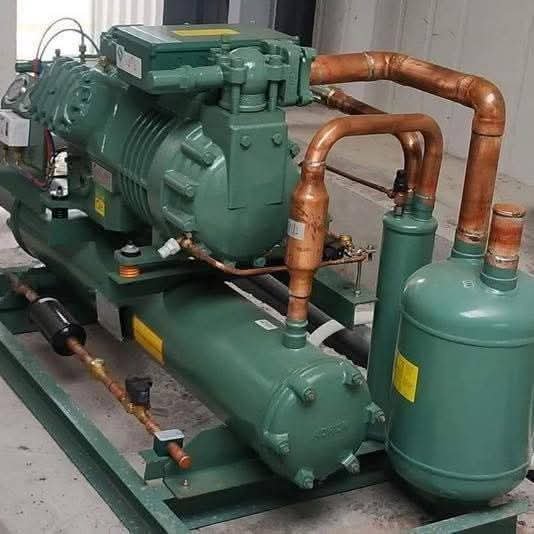
Our marine refrigeration and AC repair service covers all commercial and recreational vessel types:
Cargo vessels and bulk carriers — Jebel Ali Port, Port Rashid, Hamriyah
Passenger vessels and ferries — Provision room, accommodation, and ECR refrigeration
Fishing vessels and fish carriers — Seawater refrigeration, fish hold cooling, brine systems
Offshore support vessels and platform supply vessels — HVAC and process refrigeration
Luxury yachts — Dubai Marina, Dubai Creek, Abu Dhabi
Tugboats and barges — Provision refrigeration and crew accommodation AC
Prevent Breakdowns with a Marine Maintenance Contract (AMC)
The most cost-effective approach to marine refrigeration is prevention rather than repair. Ali Hassan Marine offers tailored annual maintenance contracts for vessels operating in UAE waters. Under an AMC, your refrigeration and HVAC systems receive:
Scheduled bi-monthly or quarterly service visits
Condenser cleaning and descaling
Refrigerant pressure checks and top-up as required
Compressor oil analysis and change
Electrical system and control panel inspection
Drain system cleaning and defrost system check
Priority emergency response at reduced labour rates
Fleet operators with multiple vessels receive a consolidated maintenance schedule and single point of contact. Contact our team to discuss an AMC package tailored to your fleet’s operating schedule and port rotation.
Frequently Asked Questions (FAQ)
How quickly can you respond to a refrigeration breakdown in Dubai?
For emergency callouts at Dubai ports including Jebel Ali, Port Rashid, and Dubai Maritime City, our typical response time is 3 to 4 hours. For vessels at Sharjah ports (Khalid Port, Hamriyah), we can often mobilise within 1 to 2 hours. We provide 24/7 emergency coverage across all UAE ports.
Which compressor brands do you service in UAE?
Ali Hassan Marine services and carries spare parts for all major marine refrigeration compressor brands including Sabroe, Bitzer, Bock, and Carlyle. We also work with Carrier, York, and other commercial HVAC compressor systems found on larger passenger vessels and offshore platforms.
Do you carry refrigerant and spare parts on-site?
Yes. We maintain a stock of R404A, R410A, and R407C refrigerants at our Sharjah facility, along with common spare parts for Sabroe, Bitzer, Bock, and Carlyle compressors. This means most repairs can be completed in a single visit without ordering parts from overseas.
What refrigerants are common on UAE vessels?
The most common refrigerants on vessels operating in UAE waters are R404A (used in cargo refrigeration and provision systems), R410A (used in modern split AC and HVAC systems), and R407C (used in retrofitted systems originally designed for R22). All refrigerant work is carried out in compliance with UAE environmental regulations by our certified engineers.
Contact Ali Hassan Marine for Refrigeration Repair in Dubai
If your vessel has a marine refrigeration problem at any UAE port — call us now. Our engineers are on standby 24/7 and can mobilise fast.
Phone / WhatsApp: +971 54 575 8205
Email: info@alihassanmarine.com
Based in Sharjah — Serving all UAE Ports: Dubai, Sharjah, Ajman, Fujairah, Ras Al Khaimah, Abu Dhabi
We provide transparent upfront quotes, documented service reports, and 24/7 emergency marine refrigeration repair across the United Arab Emirates.